Case study — anonymized. The cell, plant and product are referred to by codename ("Cell W1"). All figures are illustrative and reconstructed to protect the source, but the structure of the problem is real.
01 THE CONSTRAINT NOBODY COULD AFFORD TO MEASURE
Every plant has a cell that everyone privately agrees is the constraint. Cell W1 was that cell — a single grinding robot fed by one operator, finishing structural steel parts the rest of the line depended on. If W1 was slow, the whole value stream was slow. And yet W1 had never been properly measured.
The reason is mundane and almost universal: there was nobody to do it. A proper time study means parking a qualified engineer next to the cell for days, clipboard in hand. W1 was one of a dozen processes competing for the same thin layer of continuous-improvement capacity. So the most expensive asset in that part of the line ran on intuition: "the robot is busy", "the operator works hard", "we're probably near capacity". Three of those statements turned out to be false.
The premise was simple: if you cannot afford a human observer, let the cell observe itself — continuously, every cycle, every shift, for weeks — and let the data say where the time actually goes.
02 WHERE THE CELL SITS IN THE LINE
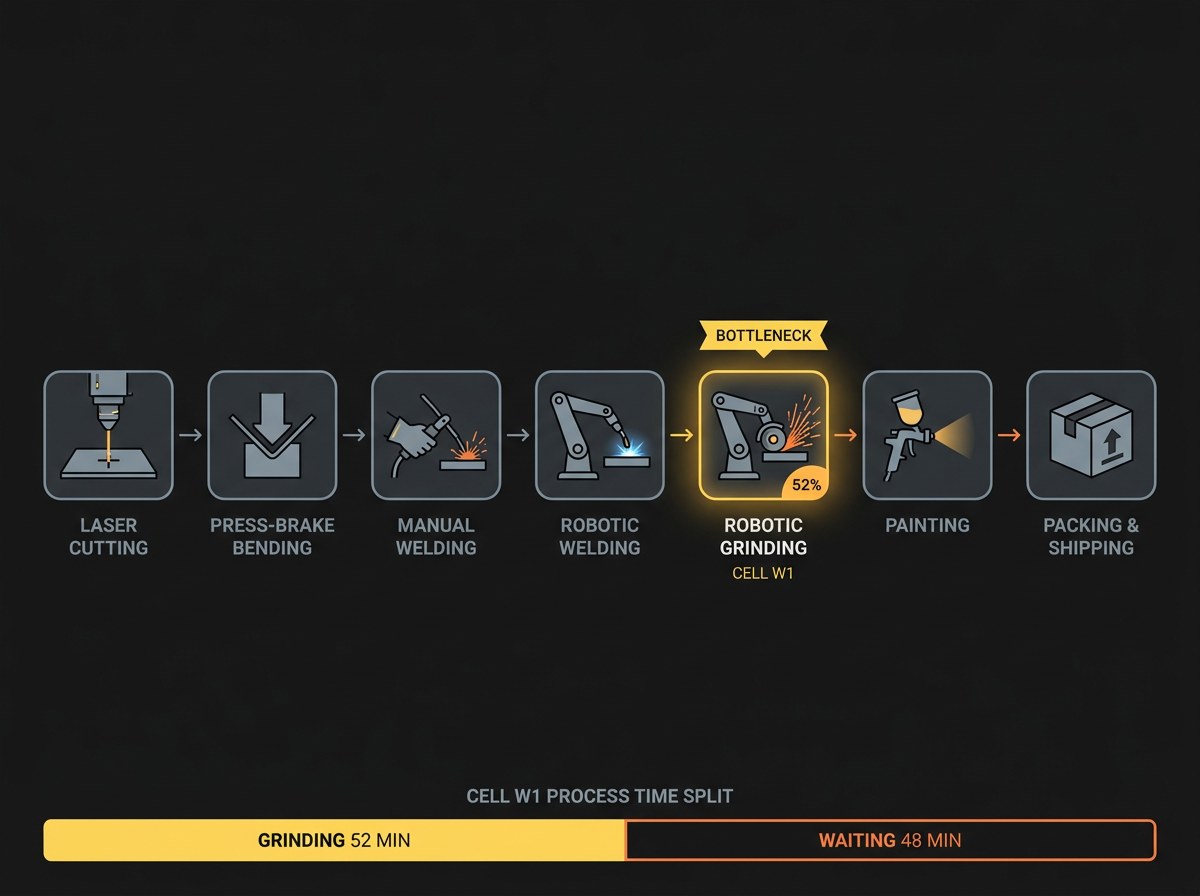
Cell W1 doesn't stand alone. It is link five in a chain: laser cutting → press-brake bending → manual welding → robotic welding → robotic grinding (Cell W1) → painting → packing & shipping. The parts that leave W1 are sub-assemblies finished at a separate plant. A bottleneck with a long downstream shadow is exactly the kind you most want to see clearly — and exactly the kind nobody has time to watch.
03 WHAT "CONTINUOUS ANALYSIS" ACTUALLY MEASURES
A robotic grinding cell looks like one machine, but it is really two interleaved systems: a robot that grinds, and a human who prepares, finishes by hand, and packs. To see whether they stay in lockstep, you measure both — separately and at once. For Cell W1, automatically and for every part: grinding cycle time (pure spindle-on time); lead time, start-to-start (the true tact of the constraint); operator activity attribution (where the operator is when the robot is idle); cell utilisation; and the full statistical shape — median, variability, outliers, and the best repeatable performance the cell has already demonstrated.
That last point is the one most analyses miss. An average tells you what is normal. It does not tell you what is possible. The gap between the two is the entire opportunity.
04 THE PICTURE THAT CHANGED THE CONVERSATION
The most disarming output was the simplest: a timeline of a single production day, with the robot's grinds on one track and the operator's location coloured underneath. You could watch a grind finish — and then a long amber band open up, because the operator was still hand-finishing the previous part at the bench. You could see the rhythm break.
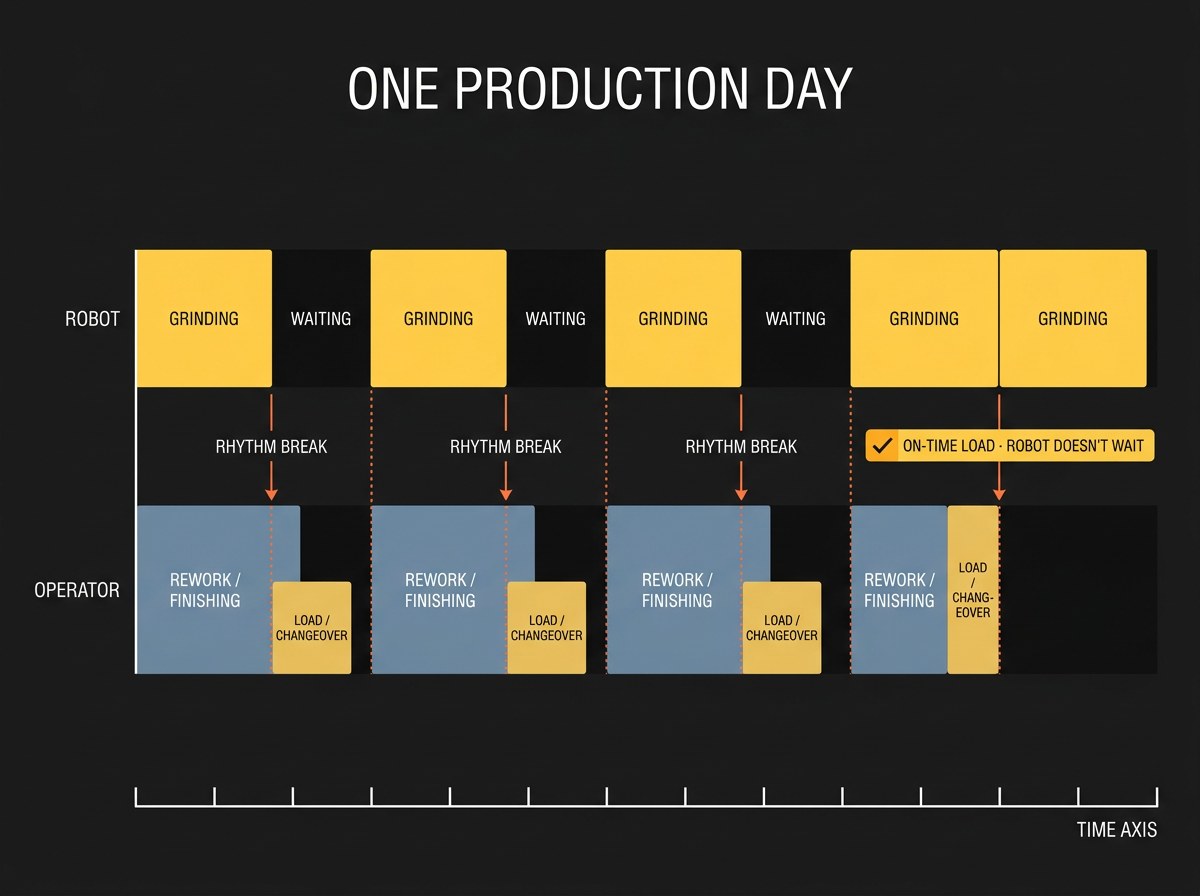
The same picture also shows the cure. Look at the cycles where the operator finishes early and swaps the part on time — the load lands inside the grind window, so the moment the spindle stops the next part is already on the jig and the next grind starts with almost no wait. Same robot, same operator: when the changeover happens during the grind instead of after it, the waiting gap nearly disappears. The few good cycles in the data are the proof that the fix works — they are the cell showing you its own best behaviour.
Read those together. The robot grinds for 52 minutes and then, on average, 48 more minutes pass before the next part starts. The constraint spends nearly half its life waiting. The "the robot is always busy" intuition was simply wrong — and no one had been able to prove it, because no one had been able to watch.
05 THE FOUR OPERATIONS — AND THE TRAP BETWEEN THEM
Around every grind the operator performs four manual operations: prep (~12 min), grinding support — load/unload/changeover (~4 min), manual rework / finishing (~14 min), and packing (~7 min). That is roughly 37 minutes of human work per part, against 52 minutes of grinding. The entire manual workload should fit inside the grinding window — the robot should almost never wait.
It waited 48 minutes per cycle anyway. The cell was not short of capacity. It was short of coordination. As tolerances tightened, the manual rework swelled past the window it was meant to hide inside, and finishing began to spill into the next cycle. The robot would stop, ready, while the operator was still heads-down hand-finishing the previous part. The bottleneck was waiting on its own operator's rework queue.
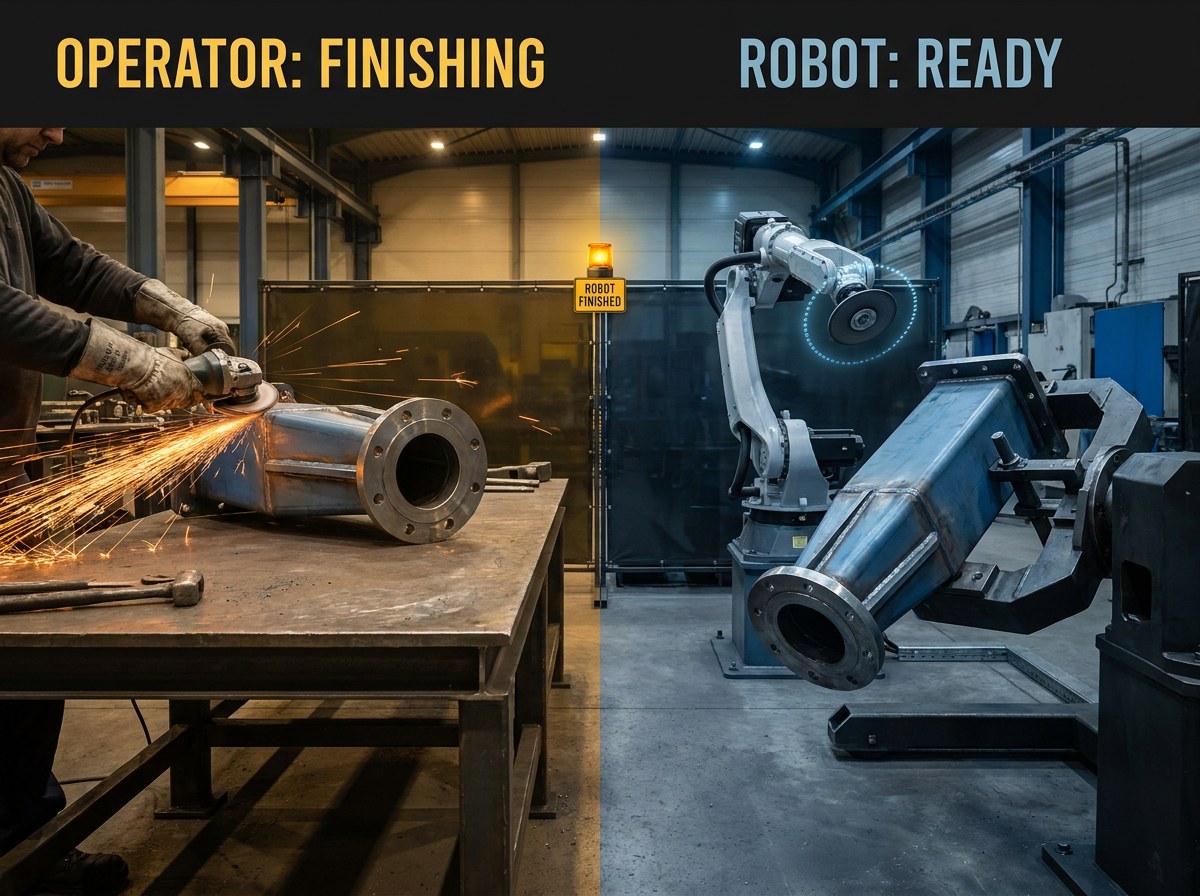
The fixes followed naturally: buffer the rework so finishing never blocks the next load, re-time finishing to the start of the grind window, and add a simple "robot finished" signal so the operator knows when to break off. The signal alone, costing almost nothing, recovered most of the lost reaction time.
06 WHERE THE OPERATOR IS WHEN THE ROBOT WAITS
Decompose the robot's idle time and the story sharpens. Of every hour the robot spent waiting:
Only 2 minutes in 60 is unavoidable changeover. Absence — the thing managers reach for first — is the smallest avoidable category. The real losses are a finishing step that overruns and prep that starts too late: sequencing problems, not effort problems. You don't fix them by pushing the operator harder — the operator is already busy 76% of the shift. You fix them by changing when the work happens relative to the robot.
07 FROM AVERAGES TO AN INTERNAL BENCHMARK
Here the analysis stopped being a report and became a target. Most dashboards stop at the average. This one asked: what is the best the cell has already proven it can do? Across the observed cycles there was a clean population of fast, clean runs — best-decile lead time around 70 minutes, with the robot grinding ~74% of the time. Not a vendor spec sheet — the cell's own best, repeatable performance.
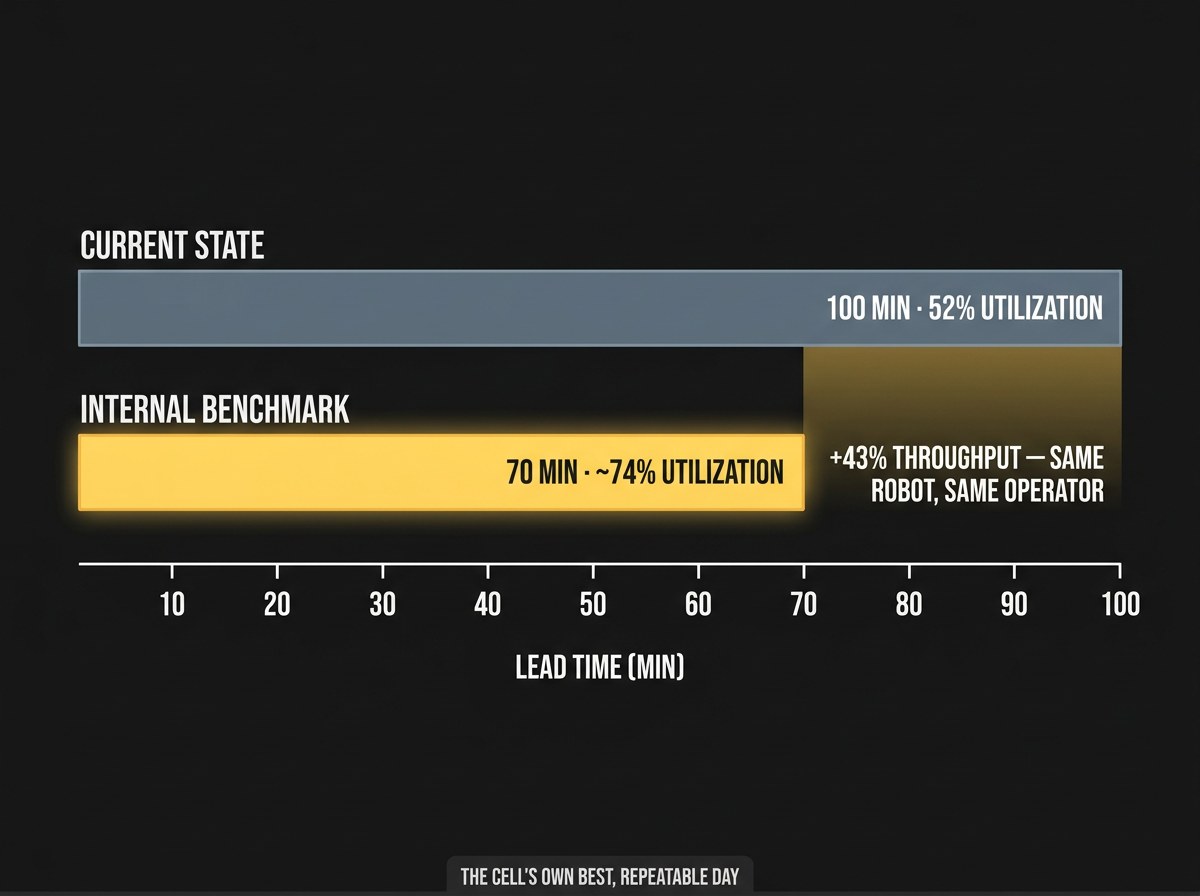
This is the difference between "the cell runs at 52%" and "the cell is leaving a fifth to a half of its output on the table, and here is exactly which behaviours close the gap." One is a number. The other is a plan.
08 THE TAKEAWAY
The bottlenecks that hurt most are often the ones too important to interrupt and too numerous to staff with observers. They become black boxes precisely because they matter — so they run on folklore, and the folklore is usually flattering and usually wrong. Continuous, automatic measurement breaks that trap: it watches every cycle, separates the machine's time from the human's, attributes every minute of waiting to a cause, and compares the everyday average against the system's own best self.