Case study — anonymized. The plant, the technology and the people are described without names. Details have been changed to protect the source, but the structure of the problem is real. And, unfortunately, typical.
01 THE PROJECT THAT HAD EVERYTHING
On paper, this project could not fail.
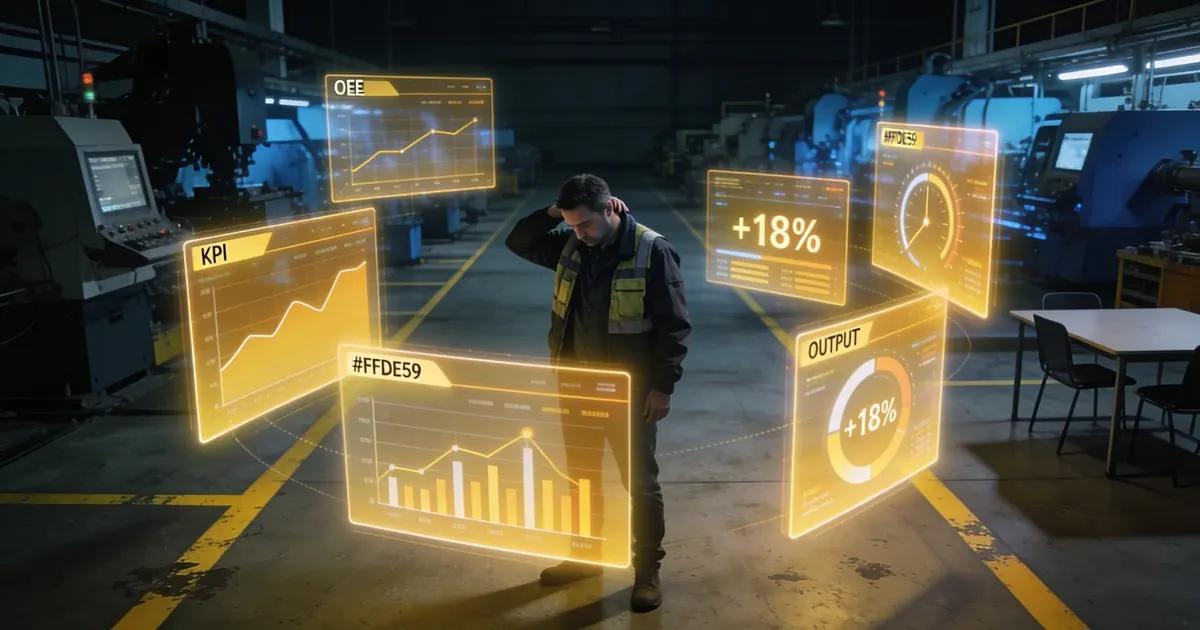
A new digital technology deployed on a production area. Installed, configured, running. The very first analysis after go-live confirmed what the plant had been whispering about for years: there is a large, measurable potential to improve results. The data left no room for doubt — losses, micro-stoppages, gaps between plan and execution, all in black and white, updated continuously.
This is the moment when most organizations declare success. The technology works, the data flows, the potential is quantified. All that's left is to reach for it.
And that is exactly when the project started to die.
02 ONE PERSON, ZERO STRUCTURE
An engineer was appointed to lead the implementation. Competent, motivated, someone who truly wanted it to work.
And that is where the list of organizational decisions ended.
No project review rules were set. Nobody defined how and when the department manager would check progress. The plant director did not have a single recurring slot in his calendar dedicated to this change. None of the leaders declared what they expected, on what horizon, or how they would know it was going well.
The engineer got a tool, access to data, and a silent assumption: "take care of it".
It's worth pausing here, because this is the heart of the whole story. A change on the shop floor requires the engagement of the production team — supervisors, operators, maintenance. And a team does not engage because somebody asks it to. It engages when it sees that the topic matters to the people who make all the decisions. To build that, you need a whole operating structure: a meeting rhythm, communication, action reviews, visible management commitment, results control, analysis of next steps.
None of it was built. What was built instead was one man with a dashboard.
03 THE TEAM WATCHES LEADERSHIP, NOT THE KPIs
Production has an infallible radar for one question: is this really important?
It doesn't look for the answer in presentations or in emails from headquarters. It looks at the behavior of its leaders. Does the manager ask about this topic at the morning meeting? Does the director show up at the results review? Does anyone come back to the actions agreed a week ago?
If the answer is "no" — and here it was "no", consistently, week after week — the team draws the only logical conclusion: this is not important. If management can't find time for it, why should an operator find energy for it?
This is not resistance to change. This is a rational response to the signals the organization sends about itself. Lack of interest from the top is not neutral — it is a message. And that message always arrives faster than any implementation plan.
04 THE CONSULTANT PROPOSES, GLOBAL "CONTROLS"
The company had the support of an operational excellence consultant. The diagnosis was accurate, the proposal concrete: build an operating system around the technology — a review cadence, roles, escalations, visual management of results, a corrective-action loop. The classics of a good implementation.
The problem was that decisions were made one level up — in global management. And global wanted two mutually exclusive things: to control everything while engaging in nothing.
It wanted to see the data, but didn't want to decide who should do what with it. It wanted visibility, but didn't want to push the change locally. It seemed detached from the plant's reality — and probably didn't fully know what it expected. Maybe it wanted to see something in the data. But what exactly — it couldn't name.
As a result, local management got the perfect alibi: if global isn't pushing, it can wait. And the engineer stayed exactly where he was — alone, between a technology that showed more and more, and an organization that looked less and less.
05 THE TECHNOLOGY DID ITS JOB. AND HERE LIES THE PROBLEM
The most bitter element of this story: the technology worked.
It uncovered the reality of the process. It exposed the weaknesses people used to argue about — now they were visible in the data, every day. It showed where time leaks away, where plan and execution diverge, where the process is unstable. It did exactly what it was paid to do.
To close the loop, only one thing was missing — the cheapest and hardest one: regular focus on daily execution. Short reviews, actions with owners and deadlines, follow-ups, consistency. Things that cost nothing except management attention.
06 THE ENGINEER WHO WANTED IT SO MUCH
For the first weeks, the engineer fought. He prepared analyses, walked the floor, showed charts, invited people to reviews. He believed that once people saw the data, it would "just click".
It didn't. Fewer and fewer people came to the meetings. Actions agreed with the team died without review. The manager was busy, the director was busy, global asked for another report. Every week without a reaction confirmed the floor's belief that the topic belonged to no one.
And a project that belongs to no one in management becomes, in the team's eyes, nobody's project — even though for one man it was everything.
Eventually the engineer stopped fighting. Not because he stopped believing in the potential — the data still showed it. He burned out because he was carrying a weight that by definition requires many pairs of hands: other people's engagement, other people's consistency, other people's attention. You cannot make up for that with your own overtime.
He wasn't ready for it. And he shouldn't have had to be — because it was never a job for one person.
07 THE COST OF LOST OPPORTUNITIES
The balance sheet after several months looks like this: the plant spent time observing and understanding the process. That is real value — the knowledge is there.
But nothing was done to introduce the change. No habits changed. No behaviors changed. Productivity did not improve. The potential the data revealed in the first weeks lay on the table the entire time — quantified, documented, and untouched.
The most expensive element of this project was not the technology. It was the lost opportunities — the difference between what the data showed and what the organization did with it. Which, in this case, means: everything minus zero.
08 WHAT WOULD HAVE TO BE DIFFERENT
This story is not about bad technology, a bad engineer, or even bad people in management. It is about a missing structure. A change with real potential needs five things before it starts:
An owner with a mandate, not a delegate with a problem. One person can coordinate a change — one person cannot carry it. A mandate means the department manager and the director have skin in the game.
A review cadence set on day one. Who, with whom, how often, on what data, with what decisions. Without it, data is a curiosity.
Visible management commitment. Not declarations — presence. The team reads the boss's calendar more carefully than his presentations.
Global either engages or hands the mandate to the local team. Control without engagement is the worst possible variant: it blocks local initiative and contributes nothing.
Daily execution over periodic analysis. A short, regular rhythm: result → deviation → action → review. Boring. And that is exactly what works.
Technology is less and less often the bottleneck. It can show you everything. The question worth asking before the project starts is: who will be watching — and what will they do with what they see?
One more thing, to close. If you want to implement change properly, you must first understand how the process actually works — and then teach the organization to operate in change. Not the other way around. Technology, data and potential are helpless against an organization that has never practiced change as a way of working.