Classic Lean gave industry the language we still use to describe waste. But the tools we write that language with — the process map, VSM, the stopwatch time study — were built for a world where data had to be collected on foot. That world is gone. LEAI — Lean + TOC + OpEx + AI — is not another methodology to roll out, nor a product to buy. It is a change in the sampling frequency of reality: from once a quarter to non-stop.
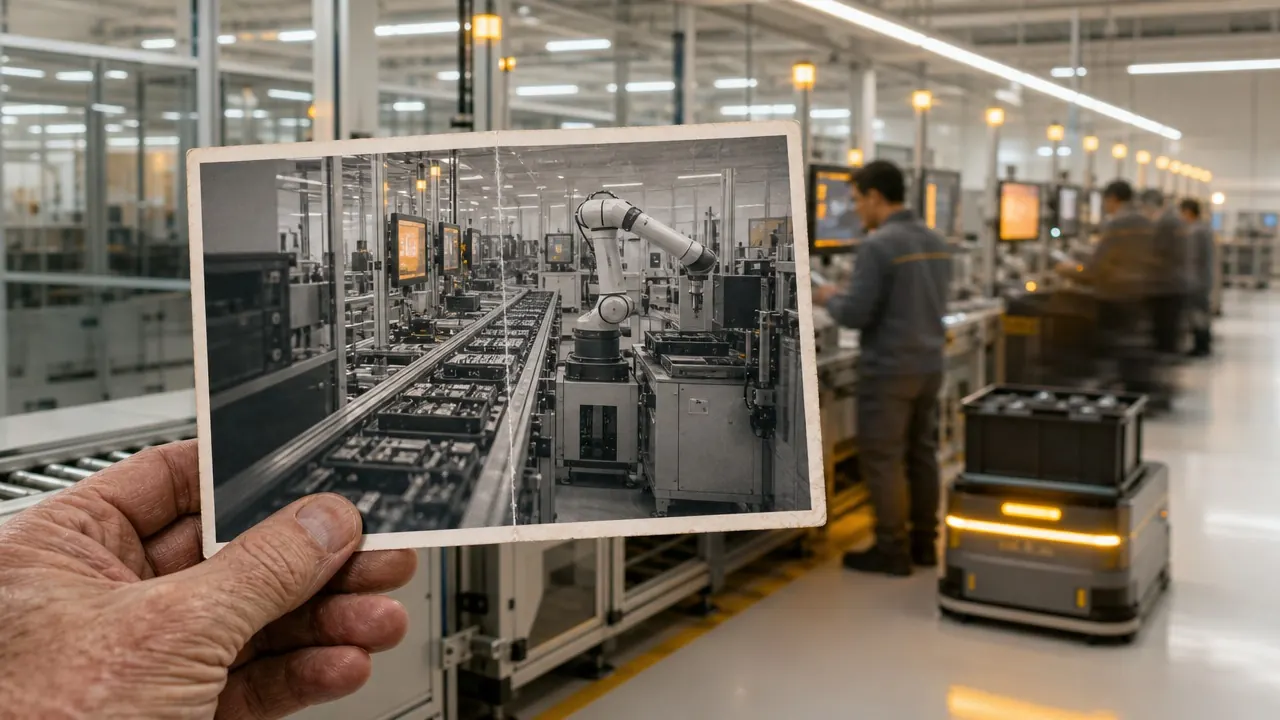
01 FIRST, HONESTLY: THIS IS NOT A TEXT AGAINST LEAN
The Toyota Production System is one of the best-documented successes in the history of operations management. Its principles — flow, takt, standardised work, waste elimination, going to the source of the problem — have no expiry date. Nobody sensible proposes replacing them.
The problem lies elsewhere and is far narrower. It concerns the measurement layer: the way we obtain data about what is really happening on the floor. That layer has not changed since the 1980s. It still rests on a human being with a sheet of paper, a stopwatch and good intentions. And it is precisely that layer that is today the bottleneck of the entire continuous improvement system.
02 YOU MAKE DECISIONS FROM A PHOTOGRAPH, BUT THE PROCESS IS A FILM
Value Stream Mapping and the process map share one built-in property: they are a photograph. A frozen frame of the process on a particular day, at a particular hour, with a particular product mix, staffing level and machine condition.
This is not a malicious reading — it is a description of the method itself. A systematic literature review combining VSM and process mining points directly to three fundamental limitations of classic mapping: the method captures "a single representative, scaled to an entire product family" and "omits dynamics and heterogeneity"; the data is collected manually, because "operation and processing times are measured with a stopwatch and inventories are counted on site"; and the whole thing rests on "interviews with operators" and "deliberate simplifications" that assume homogeneous production (Springer, 2026).
Let us break that down into four concrete business consequences.
1 · A sample instead of a population
A time study usually covers a dozen to a few dozen cycles. At an assembly station with a 90-second cycle, across three shifts, more than 2,000 cycles are performed every day. So you measure roughly one percent of events and draw conclusions about the remaining 99% from it.
Statistically that is acceptable — provided the sample is random and representative. On a real production floor it is neither. The measurement happens when the engineer has time: mid-shift, on a stable run, with an experienced operator, no breakdowns. You systematically skip exactly those moments in which the process loses the most money — start-ups, changeovers, the ends of shifts, new employees, unusual variants.
2 · The observer effect
A human with a stopwatch changes the process being measured. The phenomenon has been described in management literature since the Hawthorne studies, and every practitioner knows it first-hand: with an observer present the pace goes up, the standard is followed and the improvisations disappear. So you are not measuring the real process — you are measuring the process in its Sunday best. And then you build a capacity plan on it.
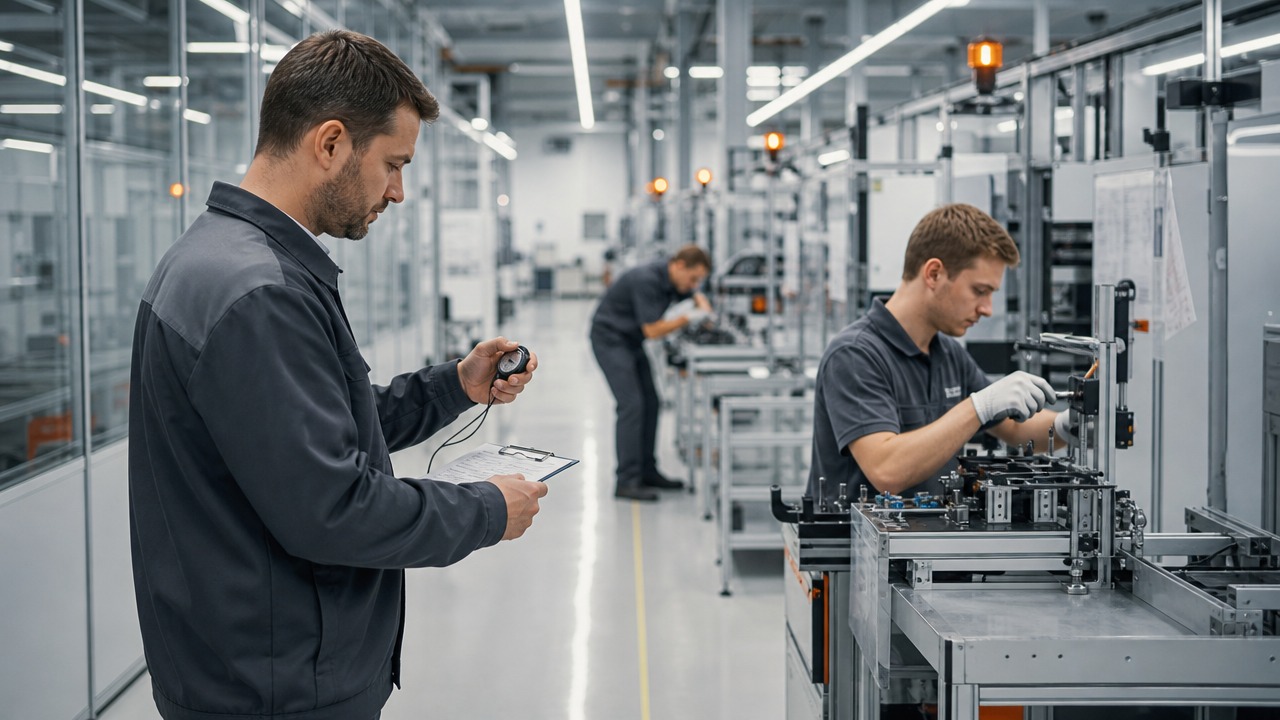
3 · The data ages faster than the report is written
A typical VSM workshop is a few days of team work, a week to draw up the current state, then more days for the future state. Before the map reaches the wall, the floor has already changed its product mix, its staffing and its bottleneck. The map describes a factory that no longer exists — and it hangs there for the next twelve months as the official picture of reality.
4 · No feedback loop after implementation
The most expensive problem and the one least often named. The classic cycle ends with the improvement implemented and verified once. Nobody measures continuously whether the standard still holds six weeks later. Every production director knows the result: the gain evaporates within a quarter, and nobody can point to the moment or the cause of the regression. The next workshop starts from scratch, often from the very same place.
03 WHAT IT REALLY COSTS
A discussion about analysis methods sounds like a topic for the CI department. That is a misclassification — it is a P&L topic. Four cost items:
The cost of people. A continuous improvement engineer can spend 30–50% of their time collecting and re-typing data. It is the most expensive form of manual labour in the plant: problem-solving experts employed as data recorders.
The cost of delayed decisions. If you learn about a drop in performance from the monthly report, you pay for that problem for four weeks before you even hear about it. On a line generating EUR 200k of margin per month, a 5% loss detected with a month's delay is EUR 10k burned purely on information latency.
The cost of decisions made on averages. VSM works with averaged values. Yet in manual processes the money sits in the tail of the distribution — in those 8% of cycles that take twice as long as the median. The average blurs them out. Continuous measurement shows the full distribution and lets you attack the specific cause of variability rather than its statistical shadow.
The cost of undetected regression. An improvement that quietly stops working is worse than no improvement at all — because you plan capacity on the basis of a result you no longer achieve.
04 LEAI: FROM PHOTOGRAPH TO STREAM
LEAI stands on four legs and none of them can be removed:
- Lean — flow, takt, standard, waste elimination. The language for describing the process.
- TOC — the theory of constraints. The answer to the question of where to look at all, so that a change translates into the throughput of the whole rather than a local optimum.
- OpEx — the discipline of the management system: goal cascade, review rhythm, accountability, sustaining the standard.
- AI — the layer that feeds the other three with facts instead of reconstructions from memory.
In practice this means the Lean measurement layer is replaced by a continuous, automatic stream of process data, and the human role shifts from recording facts to interpreting them and acting on them.
Technically the sources vary: computer vision analysing manual work, MES and PLC data, machine signals, tracking systems. The principle is the same: the process is described not from a slice of it, but from every single cycle performed.
That changes four things at once.
From sample to population
Instead of 30 measured cycles — all 2,000 a day. Instead of an average cycle time — the full distribution, with its standard deviation, its tail and the specific events that create it. Instead of "how long does this operation take", a far more valuable question appears: "why does it sometimes take twice as long".
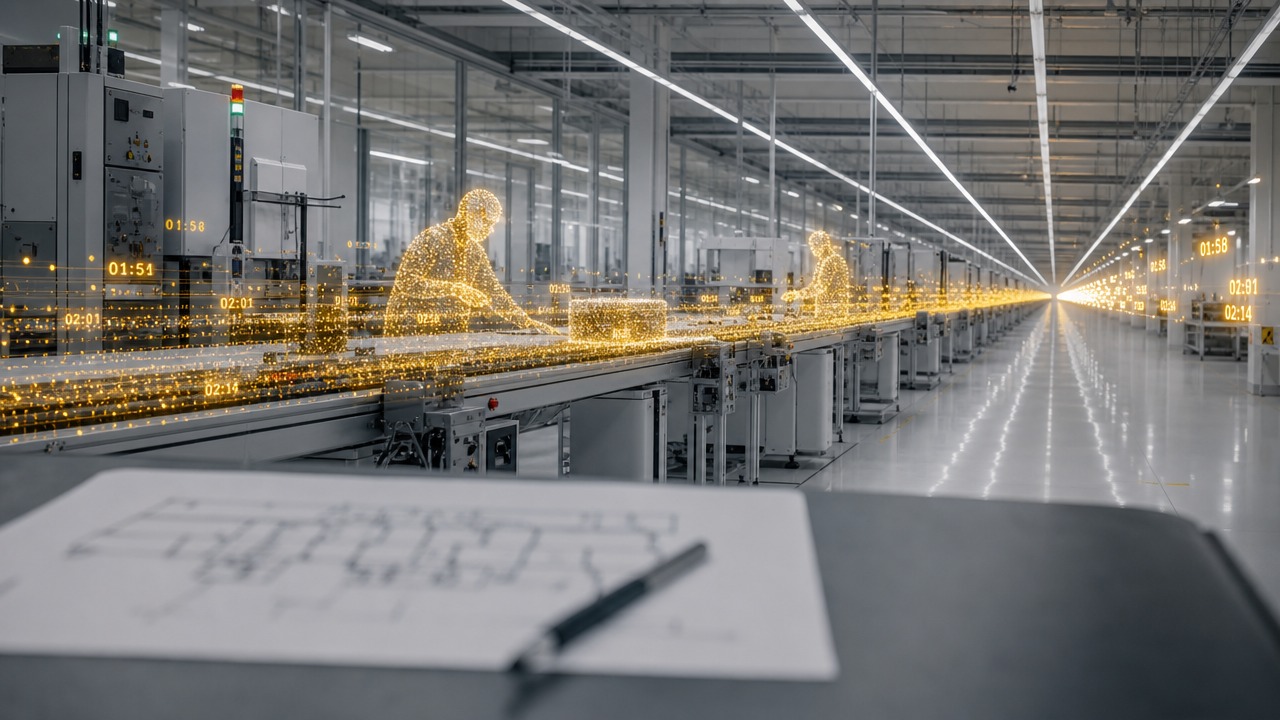
From retrospection to real time
A deviation from standard stops being a discovery in a report and becomes a signal the same day. The improvement cycle shrinks from a quarter to a shift. At that frequency the corrections are small, cheap and reversible — instead of large, expensive and risky projects.
From opinion to evidence
You know the argument: "we can't keep up because we're short of people" versus "we can't keep up because there are too many changeovers". Classically it is settled by authority or by the intuition of the most experienced person in the room. With continuous measurement it is settled by the distribution of the last six weeks of data. This is the real cultural change that arrives together with the data — operational disputes stop being political.
From project to loop
Continuous improvement stops being a series of separate initiatives with a start and an end date, and becomes a permanently running system: observation → diagnosis → change → verification that the change holds. That last part — sustainment — is what the classic toolkit cannot deliver structurally.
05 A DIRECT COMPARISON
| Dimension | Classic VSM / process map | The LEAI approach |
|---|---|---|
| Nature of the data | Snapshot, one moment in time | Continuous stream, every cycle |
| Coverage | ~1% of events (sample) | Close to 100% (population) |
| Time to insight | Days–weeks | Hours–minutes |
| Cost of the next measurement | Same as the first | Close to zero |
| Observer influence | Significant | None |
| Visibility of variability | Averaged, loses the tail | Full distribution and causes of deviation |
| Verification that the effect holds | One-off or none | Continuous, automatic |
| Engineer workload | High and recurring | One-off setup, then interpretation |
| Simultaneous scope | 1 line / 1 product family | Many lines and plants in parallel |
| Main strength | Shared understanding and team consensus | Scale, objectivity, speed |
The last row matters and it is not a courtesy. A VSM workshop has a value no system will replace: it builds a shared understanding of the process among the people who will be changing it. LEAI does not remove that value — it makes the discussion start from facts rather than from reconstructions from memory.
06 FIVE MECHANISMS THAT TURN THIS INTO RESULTS
For an investment case what counts is not the technology but the path from it to EBIT. There are five:
- Engineering time recovered. Data collection drops to zero. The CI team starts running several times more initiatives with the same headcount.
- Shorter time to detect a problem. Losses stop accumulating for weeks. This is usually the largest and fastest item to realise.
- Reduced cycle time variability. You hit the tail of the distribution instead of the average, which directly raises the real capacity of the line without any capital investment.
- Sustained gains. An improvement that does not erode has a different present value than one that disappears after a quarter.
- Scaling know-how. What you learned on one line transfers to twenty — because measuring the next line does not cost another quarter of work.
The combined effect of these five mechanisms shows up less in a single indicator than in the pace and effectiveness of the projects you run. Teams that have actually made this shift report an increase in improvement-project effectiveness of at least 40% — with the same headcount and the same budget. Not because somebody started writing reports faster. Because the whole stage of "first let's measure, then let's argue about the data, then let's decide" disappeared.
07 WHAT LEAI WILL NOT DO
Honesty with the reader matters more here than enthusiasm.
AI will not diagnose the root cause for you. It will show that variant B at station 4 takes 22% longer in the second half of the shift. Why — that is still the work of a human who knows the process. Data shortens the path to a hypothesis; it does not replace thinking.
AI will not implement the change. Standardising the work, convincing the team, redesigning the workstation — that is still Lean, people and leadership.
Data without the trust of the workforce does not work. If the system is perceived as a tool for surveilling employees, the project dies regardless of the quality of the technology. The communication layer, transparency of purpose, agreements with employee representatives and GDPR compliance are not a formality — they are a precondition for success. Computer-vision-based solutions should analyse the process, not people.
Not every workstation is worth measuring. Start where the constraint and real variability are — TOC says it plainly: improvement outside the bottleneck is an expensive illusion. The rest can wait.
08 FAQ
Does LEAI replace Lean?
No. It replaces the way data is collected for Lean. The principles, the problem-solving tools and the continuous improvement culture stay — they simply get a reliable input.
Does this mean the end of VSM?
Not as a tool for building shared understanding. Yes — as the primary source of truth about process performance. A VSM drawn on continuous measurement data is simply a better VSM.
We have an MES and plenty of data, and still nothing comes out of it. What changes?
An MES sees transactions and machine events. It does not see manual work: micro-stops, waiting, walking, rework. In manual assembly that is exactly where most of the losses sit — and that is the gap LEAI closes.
Isn't this just employee monitoring?
The purpose is different and it has to be communicated clearly: what is analysed is the process, not the performance of specific individuals. Systems of this class are designed with anonymisation and GDPR compliance in mind. If a vendor cannot explain this in five minutes — that is a bad vendor.
How long does it take?
The first conclusions are usually a matter of weeks, not quarters — because the data collects itself from day one, rather than when an engineer finds a window in the calendar.
09 WHAT LEAI IS NOT
Let us say it plainly, because there is a lot of conceptual mess in this category.
LEAI is not a product name and not a vendor name. You cannot buy LEAI. It is a way of working, and the specific tools — anyone's — are interchangeable within it. Whoever sells you LEAI in a box is selling you something else.
LEAI is not the AI most people have in mind today. It is not about writing emails, generating pretty pictures, summarising documents or yet another agent framework built on an off-the-shelf model. That is the demo layer — flashy and shallow. LEAI is using AI for real: integrating genuinely available data with process knowledge so that the process actually runs better. The difference is the one between a demo and production.
LEAI is not a rejection of the classics. Lean, TOC and OpEx stay in the foundation — without them AI generates charts, not results. What we do reject is what has grown around the classics and started to impersonate them: Excel as a measurement system, PowerPoint as evidence, the workshop as a ritual, and the worn-out paradigms in which "we analysed it" means "somebody spent a week re-typing numbers".
This is the spirit of the times, and it overwhelms many people — some it simply frightens — because it invalidates twenty years of practice in collecting data by hand. I understand the resistance. But a process engineer equipped with a continuous data stream and an AI that can process it is not the same engineer they were a year ago.
And one more thing, quite frankly: whoever has not experienced it has nothing to discuss — not from a lack of knowledge, but from a lack of a reference point. If, after encountering AI in your own processes, you do not feel like you jumped to light speed, it does not mean the technology failed. It means you are still at the stage of using AI to look up offers.
10 A NEW PROFESSION ON THE HORIZON: CIAI
Because there is one element in this whole puzzle that is talked about least and decides everything: the human being. Specifically — the continuous improvement engineer, who stops being a recipient of tools and becomes their operator and creator.
It is a new role and it deserves its own name: CIAI — Continuous Improvement + AI.
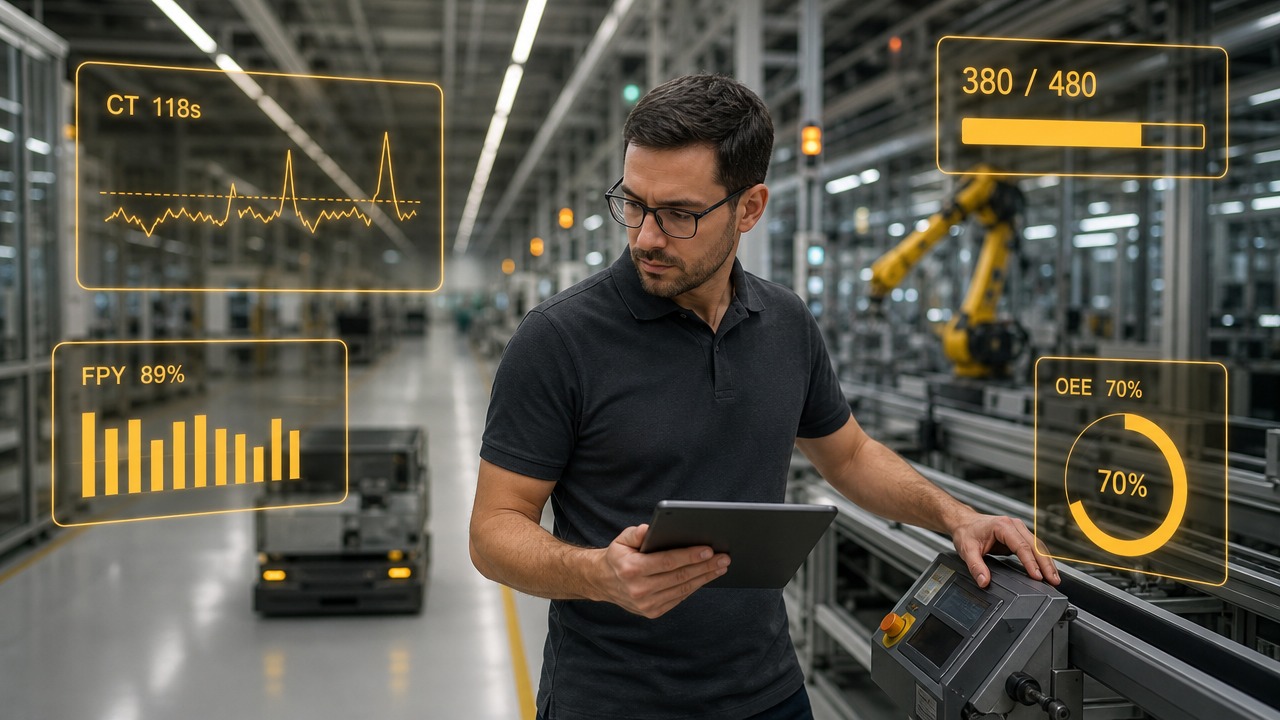
Who is a CIAI? Above all, a practitioner. They know the process inside out, they have been on the floor, they understand takt, the constraint and why an operator works around the standard. Without that the rest is useless — AI in the hands of someone who does not understand the process produces very fast nonsense.
But on top of that knowledge comes a skill set that was not in a CI engineer's job description even five years ago. A CIAI uses AI for advanced analyses that previously were not commissioned from anyone because they took too long. They build their own measurement tools instead of waiting a quarter for a budget and a vendor. They integrate data sources that have sat next to each other in the company for years and never met — MES, ERP, vision, shop-floor spreadsheets, quality systems. And then they put it in front of people in a form they will actually use: a dashboard at the line, a customised report for the board, an internal page, a tool for running projects. On their own. In days, not quarters.
And here it gets genuinely interesting, because the direction is already visible. The future of CI is not one person clicking through tools faster. It is a super-agent equipped with the tools of the future — and ultimately a manager of agents: someone who does not perform the analyses personally but designs, commissions and supervises the work of a set of specialised AI agents, keeping for themselves what they are irreplaceable at — judgement, priority, decision and accountability.
I know how that sounds. Odd. But it is one of the very likely paths — and in my view the most interesting thing that will happen to the CI profession this decade.
What a CIAI's working day looks like and what competencies the role demands — in the next article.
11 SUMMARY
Classic Lean tools are not wrong. They are under-sampled — they were created in an era where every measurement cost hours of human work, so the methodology rationally minimised the number of measurements. That cost has just fallen to almost zero, and the methodology has not caught up.
The consequence for the board is simple. If your factory makes decisions about capacity, staffing and investment on the basis of an analysis done a quarter ago on one percent of events — then you are not managing the process. You are managing its photograph.
LEAI is not a system to buy. It is the decision to stop looking at stills and start watching the film — with Lean, TOC and OpEx in the foundation, and AI as the layer that finally shows the floor as it really is.